How to write a press release in India (with a template)
A journalist’s inbox is full by 10 in the morning. Launches, funding rounds, event invites, award announcements, all asking for attention at once. Most of them …
A journalist’s inbox is full by 10 in the morning. Launches, funding rounds, event invites, award announcements, all asking for attention at once. Most of them are deleted in a few seconds, not because the news was bad, but because the press release was hard to read.
A good press release does one job. It makes a journalist’s work easy. This guide shows you how to write a press release in India that gets read, with a simple template you can use right away.
What a press release is, and when to send one
A press release is a short, factual announcement written for journalists, not for customers. It tells them what has happened, why it matters and who to speak to for more.
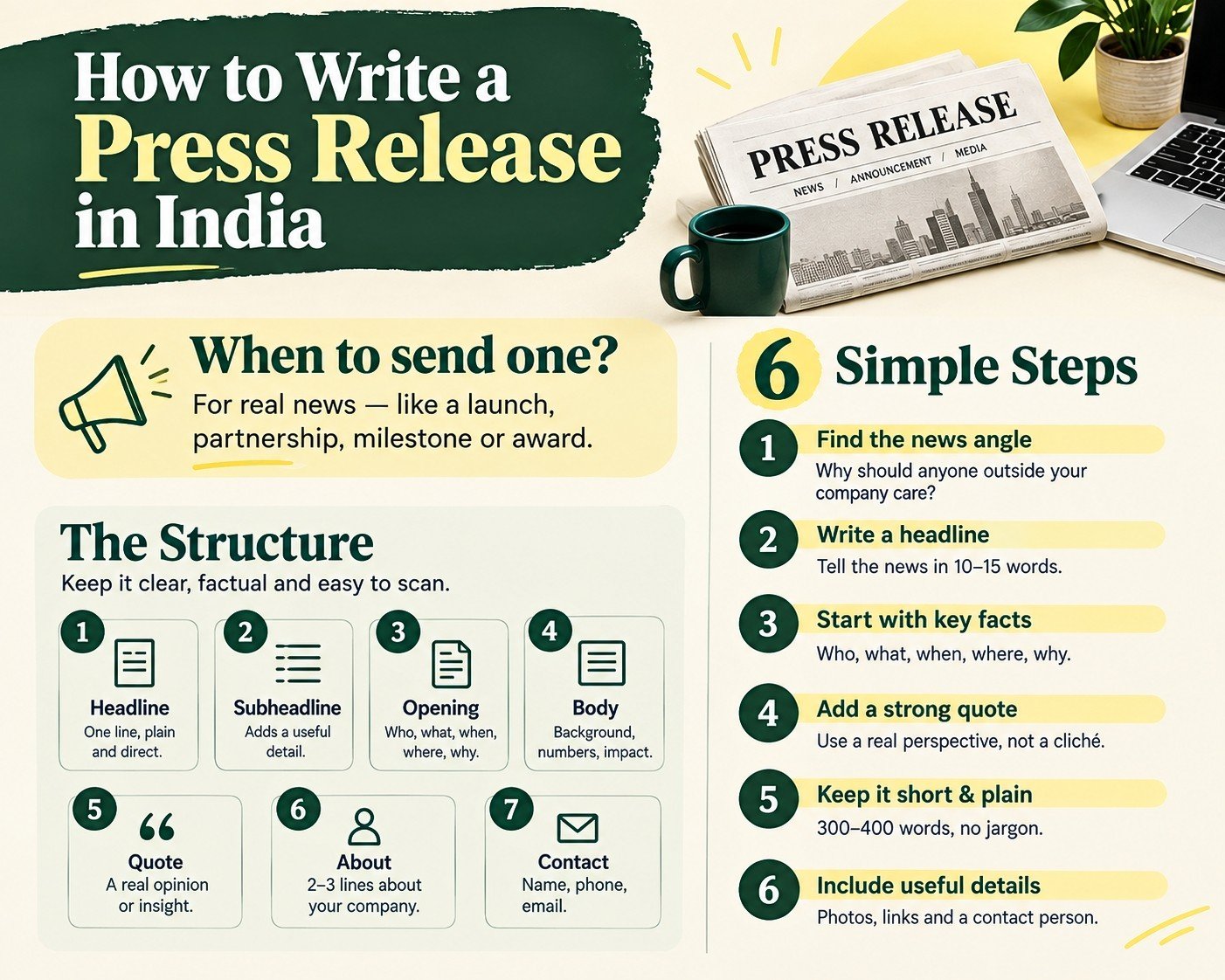
Send one when you have real news: a launch, a partnership, a new office, a milestone, an award, a research finding, a film or music release, or a public appearance. Don’t send one for routine updates. If you would not stop scrolling for it yourself, a journalist will not stop either.
The structure of a good press release
A press release follows a simple order. The most important information goes first, so a journalist can understand the story from the first two lines.
- Headline: one line that states the news plainly
- Subheadline: one line that adds the most useful detail
- Opening paragraph: who, what, when, where and why, in two or three sentences
- Body: the background, the numbers and why the news matters
- Quote: one or two lines from a founder, artist or spokesperson that add a point of view
- About section: two or three lines about the company or person
- Contact details: name, phone number and email of the person journalists can reach
Step 1: Find the news angle
Ask what is new, who it affects and why anyone outside your company should care. “We launched a new product” is a fact. “A Mumbai startup launches a product to solve a problem that thousands of small businesses face” is a story. The angle is usually the reason someone outside your company would care.
Step 2: Write a headline that says the news
Skip the clever wordplay. A headline should tell a journalist what happened in about ten to fifteen words. Put the subject and the action up front, for example: “[Company] launches [product] for [audience].”
Step 3: Put the key facts in the first paragraph
If a journalist reads only the first paragraph, they should still know the story. Include who is announcing, what they are announcing, when and where it is happening, and why it matters. Everything after that is supporting detail.
Step 4: Add one strong quote
A quote gives journalists something they can use directly in their article. Make it a real opinion or insight, not “we are excited to announce”. Say something that explains why this matters or what comes next.
Step 5: Keep it short and plain
One page, around 300 to 400 words, is enough. Write in the third person, use simple words and avoid jargon, buzzwords and heavy adjectives. Let facts do the work.
Step 6: Add the details journalists need
Include a short “About” section and a contact person who will actually answer. Add a link to a folder with good photos, logos and any supporting material, so journalists don’t have to ask for them.
A simple press release template
HEADLINE: [Company or person] [does what] [for whom / key detail]
Subheadline: [One line that adds the most useful extra detail]
MUMBAI, [Date]: [Company or person] today announced [what]. [Why it matters in one sentence]. [Where and when it happens, or when it is available].
[Body paragraph 1: the background and the problem this solves]
[Body paragraph 2: one or two key facts or numbers that support the story]
“[A real opinion or insight in one or two sentences],” said [Name, Title].
[Closing line: what happens next, or where people can learn more]
About [Company or person]
[Two or three lines on who you are and what you do]Media contact
[Name] | [Phone] | [Email]
Photos and press kit: [Link]
How to send it
- Paste the press release into the body of the email so it is easy to read on a phone
- Use a subject line that states the news, not “Press Release”
- Add a short personal line at the top for the journalist you are writing to
- Share photos through a link instead of attaching large files
- Send it early in the day, and follow up once if you hear nothing
Common mistakes in Indian press releases
- Writing it like an advertisement. Journalists want facts, not claims about being the best.
- Burying the news. If the key fact is in paragraph four, most readers will never reach it.
- Sending it to everyone. Send it to journalists who actually cover your topic.
- Missing contact details. A journalist who cannot reach you quickly will move on.
- Making it too long. Several pages of text often go unread.
- No visuals. Good photos can decide whether a story gets used.
How Sorta Famous helps with press releases
Sorta Famous is a PR and marketing agency based in Andheri, Mumbai, that helps founders, brands and public figures get covered. We begin with an audit to understand your story and your goals, then write and place press releases that are built around real news, not filler. Our work can be on a project basis, with no long-term retainer, and you deal directly with the strategists handling your campaign.
If you have news to share and want help getting it covered, get in touch with Sorta Famous for a free 30-minute consult.
Frequently asked questions
How long should a press release be?
About one page, or 300 to 400 words. Journalists prefer short and clear over long and detailed.
Is a press release still useful in India?
Yes, when it announces real news and is sent to the right journalists. It works best as one part of a wider media plan, not on its own.
What should I write in a press release headline?
State the news in plain words, in around ten to fifteen words. Lead with the subject and the action, and skip wordplay.
Can I write a press release myself?
Yes. Follow a clear structure, keep it factual and have someone else read it before you send it. An agency helps most with the news angle and getting it to the right journalists.
Should I send a press release as an attachment?
It is usually better to paste it in the body of the email. Attachments are often skipped, especially on mobile.
How often should I send press releases?
Only when you have real news. Sending too many weak releases makes journalists less likely to open the next one.