How to pitch a journalist in India: A simple guide
Most pitches to journalists fail for the same reason. They are about the sender, not the reader. “We are excited to announce” is a line journalists see dozens o…
Most pitches to journalists fail for the same reason. They are about the sender, not the reader. “We are excited to announce” is a line journalists see dozens of times a day, and they know exactly what comes next: a request for free coverage with no real story behind it.
A good pitch works differently. It shows a journalist, in a few lines, why their readers would want this story. This guide explains how to pitch a journalist in India, step by step, with a sample email you can adapt.
What Journalists Actually Want
Journalists are looking for stories their audience will care about. They are short on time, they get a large number of emails, and they are judged on what they publish, not on what they are sent. A pitch that helps them do their job, with a clear angle, useful facts and easy access to the right person, has a real chance.
Step 1: Pick the Right Journalist
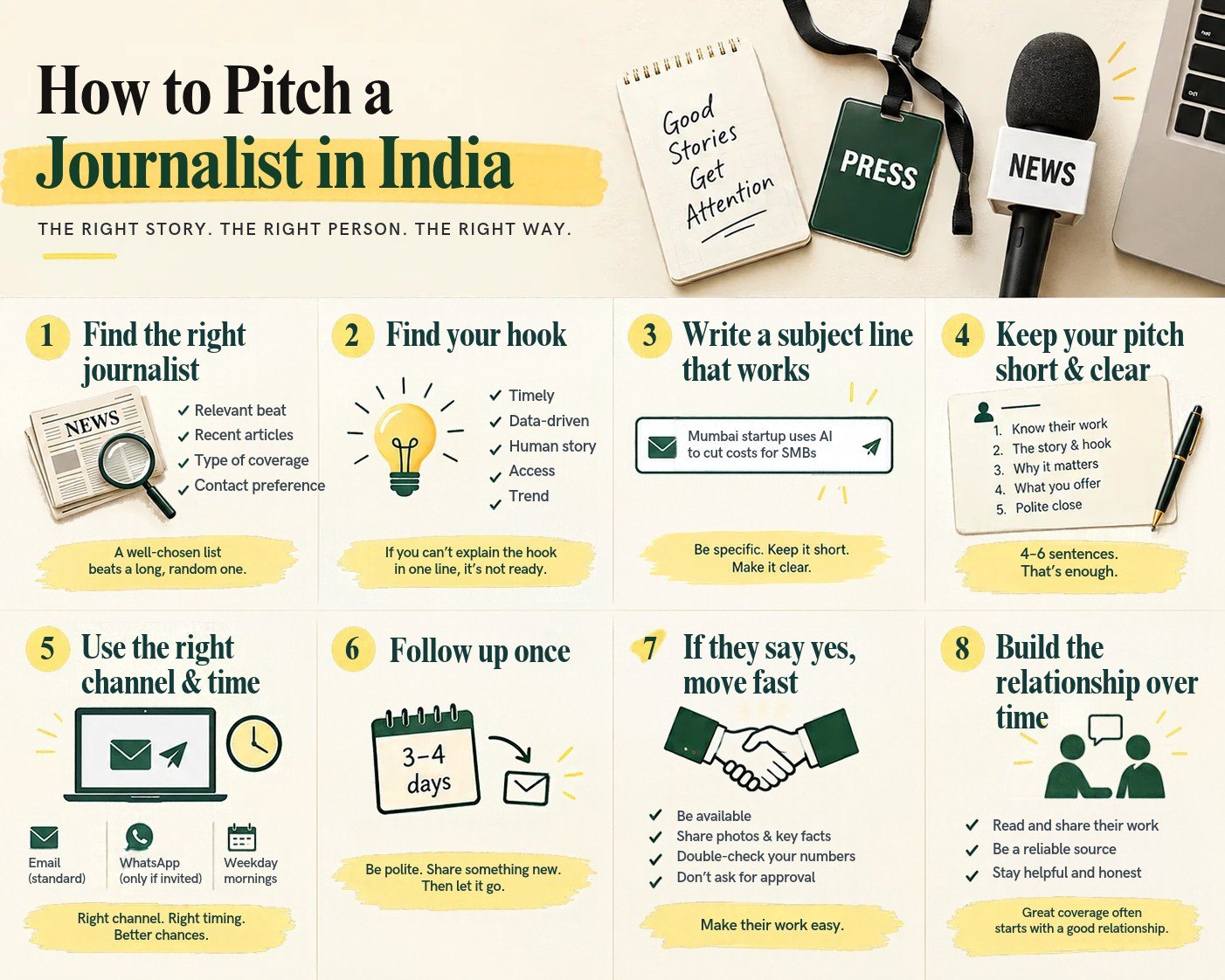
The most common mistake is pitching someone who doesn’t cover your topic. Before you write anything:
- Find journalists who cover your industry, city or type of story.
- Read their last few articles to see what they write about and how.
- Note whether they write features, quick news, interviews or opinion.
- Check whether they have said how they prefer to be contacted.
A short list of ten well-chosen journalists is better than a list of two hundred random ones.
Step 2: Find Your Hook
The hook is the reason this story matters now. Good hooks include:
- Timeliness: It connects to something already in the news or a season, festival or event.
- Data: You have a number, survey or finding that is new.
- A human story: A person, a struggle or a turning point readers will relate to.
- Access: You can offer an interview, a behind-the-scenes look or an expert view.
- A trend: Your story shows something bigger that is changing.
If you can’t explain the hook in one sentence, the pitch is not ready.
Step 3: Write a Subject Line That Does the Work
Most journalists decide from the subject line whether to open an email. Make it specific and plain. “Mumbai startup uses [method] to cut [problem] for small businesses” says far more than “Exciting news from our company”. Keep it short enough to read fully on a phone.
Step 4: Write a Short Pitch
A good pitch is usually four to six sentences. It should cover:
- A one-line greeting that shows you know their work.
- The story and the hook in two or three sentences.
- Why it matters to their readers.
- What you can offer, such as an interview, data or photos.
- A polite close, with your contact details.
Here is a simple template:
Subject: [Specific story in one line]
Hi [Name],
I read your recent piece on [topic], especially [one specific point].
I wanted to share a story that connects to it: [one or two sentences on the news and the hook, with one key fact or number].
I thought it might interest your readers because [reason].
I can offer [an interview with the founder / the full data / photos and a short video], and I am happy to work around your deadline.
Thank you for your time.
[Name]
[Role / Company]
[Phone] | [Email]
Step 5: Choose the Right Channel and Time
Email is the standard way to pitch. Use WhatsApp only if the journalist has given you their number or you already have a working relationship, and keep it to one short message. Send pitches on weekday mornings, and avoid late nights and weekends unless the story is time sensitive. If a journalist has a known deadline, avoid pitching them near it.
Step 6: Follow Up Once
If you hear nothing, follow up once after three or four days. Keep it short and add something new, such as a fresh fact or a photo, instead of just asking if they saw your email. If there is still no reply, let it go and try again with the next story.
Step 7: If They Say Yes, Move Fast
When a journalist responds, reply quickly and make their work easy:
- Be available when they need you.
- Have photos, logos and key facts ready in a shared link.
- Check your facts and numbers before you send them.
- Don’t ask to review or approve the article, unless it was agreed in advance.
After the story is published, thank them and share it.
Step 8: Build the Relationship Over Time
The best coverage often comes from relationships built over months. Read and share journalists’ work, respond to their calls for sources and be a reliable, honest voice when they need a quote. Even a polite “no” can turn into a “yes” next time if you stay helpful. This is also how public figures stay in the news and stay relevant long after a single story runs.
Common Mistakes When Pitching Journalists
- Sending one email to a long list: Mass emails are easy to spot and easy to delete.
- Writing a long pitch: If it needs scrolling, it is too long.
- Making it about your product: Lead with the story, not your company.
- Attaching heavy files: Share a link instead.
- Following up every day: One polite follow-up is enough.
- Disappearing after a yes: A slow reply can end the opportunity.
How Sorta Famous Helps
Sorta Famous is a PR and marketing agency based in Andheri, Mumbai. Media relations is at the heart of what we do, and we pitch stories to journalists who actually cover them, as we did for Anangsha Biswas and Shivam Khajuria. Every engagement starts with an audit of your story and your goals, followed by a media plan built around real news. Support can be project-based, with no long-term retainer, and you work directly with the strategists handling your pitches.
If you would like help getting your story in front of the right journalists, get in touch with Sorta Famous for a free 30-minute consult.
Frequently Asked Questions
How Do I Find a Journalist’s Email Address in India?
Check their author page on the publication’s website and their social media profiles, where many journalists share how to reach them. Use only contact details that are public or given to you.
How Long Should a Pitch Email Be?
Four to six sentences is enough. Lead with the story and keep the rest short.
Can I Pitch a Journalist on WhatsApp?
Only if they have shared their number with you or you already have a working relationship. Otherwise, email is the safer and more professional route.
How Many Times Should I Follow Up?
Once, after three or four days, with something new to add. After that, move on and pitch again with your next story.
Should I Pay a Journalist to Cover My Story?
No. Paid placements are advertising and should be labelled that way. Earned coverage is more credible because it is chosen on merit.
What If a Journalist Says No?
Thank them politely and stay in touch. Journalists remember people who are helpful and respectful, and may come back for a future story.