Brand management for small businesses in India
Many small business owners think a brand is a logo and a colour palette. Then a customer finds them on Google, sees a different look on Instagram, gets a rushed…
Many small business owners think a brand is a logo and a colour palette. Then a customer finds them on Google, sees a different look on Instagram, gets a rushed reply on WhatsApp and a plain invoice by email, and quietly wonders if it is the same business. That gap is exactly what brand management is meant to close.
Here is a simple guide to brand management for small businesses in India, with steps you can start on without a big team or budget.

What is brand management?
Brand management is the ongoing work of shaping how people see your business. It covers your name, your look, the way you talk, how you treat customers and what people say about you when you are not in the room. A logo is one small part of it. The bigger part is whether every experience a customer has with you feels like it came from the same business.
Why small businesses in India need it
Customers in India have more choice than ever, and they compare quickly. Before they buy, they check your website, scroll your social pages, read your Google reviews and often ask someone they know. A business that looks and sounds consistent feels safer to buy from.
Brand management also protects you as you grow. When your identity is clear, new team members, designers and partners can represent you correctly without asking you every time.
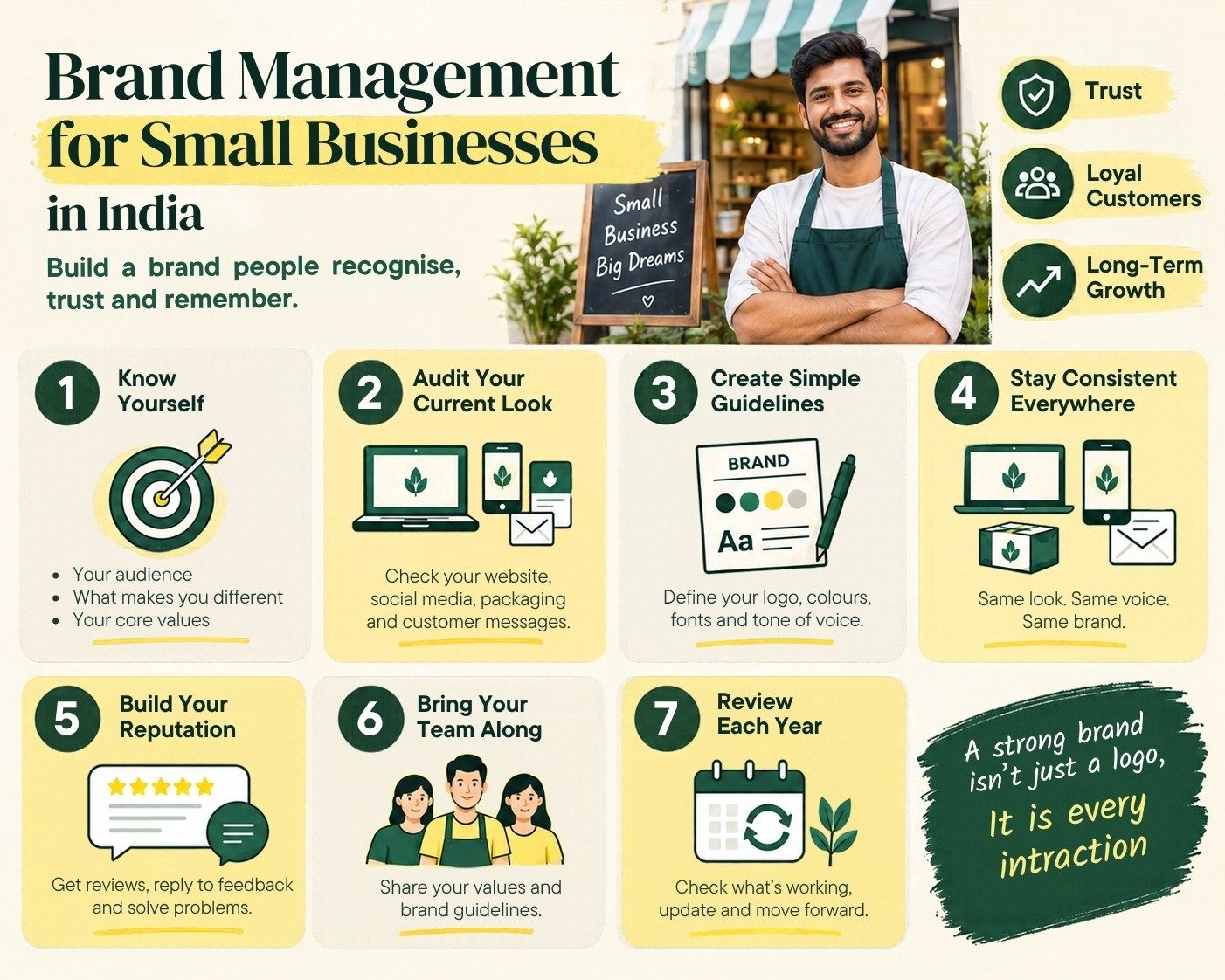
Step 1: Define who you are
Before touching a logo or a colour, answer a few plain questions:
- Who exactly are you trying to serve?
- What do you do better or differently than the alternatives?
- What do you want customers to say about you after they have worked with you?
- Which three words describe your business at its best?
Write the answers down in a short paragraph. This becomes the foundation for every brand decision that follows.
Step 2: Audit how you look and sound today
Most small businesses are surprised by how inconsistent they already are. Look at every place a customer meets your brand:
- Your website and Google Business Profile
- Your social media pages and bios
- Packaging, invoices, brochures and visiting cards
- How you and your team reply on calls, email and WhatsApp
Note where the look, tone or message changes from one place to another. These are the first things to fix.
Step 3: Create simple brand guidelines
You don’t need a fifty page document. A single page is enough to start. Include:
- Your logo and how it should and should not be used
- Two or three brand colours and one or two fonts
- Your tone of voice, for example warm and direct, or formal and precise
- Words and phrases you use, and ones you avoid
Share this page with everyone who creates anything on your behalf.
Step 4: Stay consistent at every touchpoint
Consistency is where most of the value of a brand comes from. Use the same name, the same look and the same way of speaking on your website, your social media, your packaging and your customer messages. People should be able to recognise you even without seeing your logo.
Step 5: Look after your reputation
Your reputation is part of your brand, and it is built in small moments:
- Ask happy customers for Google reviews and thank them when they leave one
- Reply to complaints calmly and quickly, in public and in private
- Keep your business details accurate everywhere they appear online
- Fix the root cause of repeated complaints instead of only apologising
How you handle a problem often shapes opinion more than how you handle a good day.
Step 6: Bring your team along
Every person who talks to a customer is representing your brand. Take half an hour to walk your team through your one page guidelines, explain what the business stands for and show them how to handle common situations in your voice. A brand that only the owner understands will not stay consistent for long.
Step 7: Review once a year
Businesses change. New products, new customers and new competitors can all make your brand feel out of date. Once a year, repeat the audit from Step 2, update your guidelines and fix whatever has drifted.
Common mistakes small businesses make with branding
- Treating a logo as the whole brand. A good logo cannot fix an inconsistent customer experience.
- Changing the look every few months. Constant changes stop people from recognising you.
- Trying to appeal to everyone. A clear audience makes your message stronger.
- Different tone on every platform. Customers should not feel they are speaking to different businesses.
- Ignoring reviews and complaints. Public silence reads as a lack of care.
- Leaving branding to one person. If it only lives in someone’s head, it disappears when they are busy or leave.
How Sorta Famous helps with brand management
Sorta Famous is a Mumbai-based PR and marketing agency that helps businesses build brands people recognise and trust. All of our engagements start with an in-depth audit of your current visibility and goals, followed by a strategy built around your calendar and not a generic content plan. This includes positioning work, media relations to earn outside credibility, and reputation management to protect what you build. We also give project-based support without a long-term retainer, and there are no account managers in between. You work directly with the strategists running your campaign.
To start building a brand with a strategy behind it, get in touch with Sorta Famous for a free 30-minute consult.
Frequently asked questions
What is brand management in simple words?
It is the ongoing work of shaping how people see your business, through your name, look, voice, customer experience and reputation, so that everything feels consistent.
Is brand management only for big companies?
No. Small businesses often benefit the most, because a clear and consistent brand helps them stand out against larger competitors without a large marketing budget.
What is the difference between branding and marketing?
Branding is who you are and how you are perceived. Marketing is how you get that message in front of people. Strong marketing works much better on top of a clear brand.
How much does brand management cost?
It depends on the scope. You can start for free with a simple audit and a one page guideline, and bring in an agency when you need positioning, press and reputation support.
How long does it take to build a brand?
The basics can be set in a few weeks. A strong reputation takes much longer, because it is built through consistent experiences over months and years.
Do I need a designer for brand guidelines?
A designer helps with the logo, colours and fonts, but the most important parts, such as your positioning and tone of voice, come from you and can be written down without one.