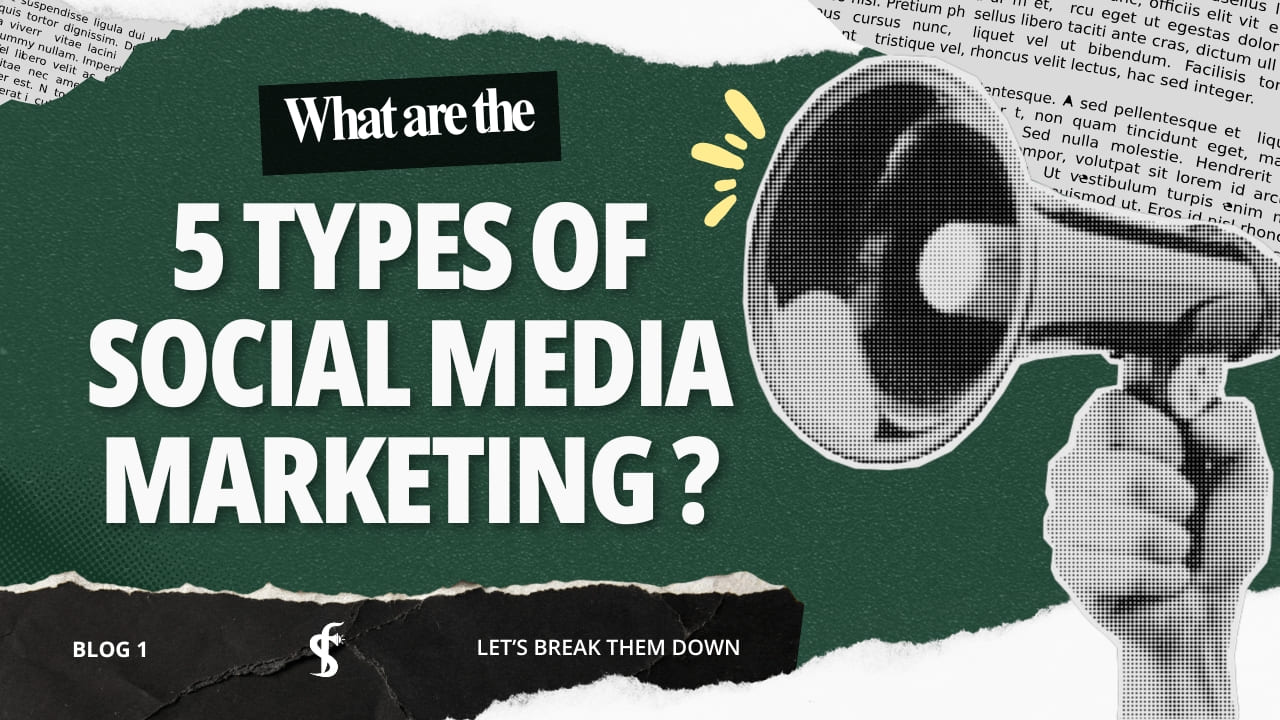
What are the 5 types of Social Media Marketing?
The 5 types of social media marketing are content marketing, paid social advertising, influencer marketing, community management, and social commerce. Each one …
The 5 types of social media marketing are content marketing, paid social advertising, influencer marketing, community management, and social commerce. Each one plays a different role. Some build awareness while some of them help you to drive sales. But for most brands to grow, they need to find a balanced mix of all five.
A lot of people think social media marketing just means posting pretty pictures and hoping for likes. But that is just a very small piece of it. The brands that actually grow on social media treat it as a system and not as a hobby. And that is where you need professionals like Sorta Famous to come in and drive that balance for you.
Each type below handles a different part of that system. Let’s break each one down properly, with real examples and how to actually start using each one.
5 types of Social Media Marketing
1. Content Marketing
This is the type of marketing that most of the people will think of first as soon as they hear the word marketing.
Posting on Instagram, TikTok, LinkedIn, or X without paying to boost it.
It includes photos, videos, memes, carousels, polls, whatever fits the platform and the need at hand. Herein the goal is simple, to get people to notice you and remember you before they eventually start to trust you.
Duolingo is a great example of this. Their TikTok account barely talks about language learning. Instead, they post random skits with their owl mascot which gains them millions of views. Almost no direct selling. But everyone knows the brand now.
Okay, I know what you’re thinking. “That’s great for a big company, what about a small business?”
Content marketing actually works better for small businesses in some ways. You don’t need a huge budget but you need consistency and a clear idea of what your audience wants to see.
Types of content that work well
- Educational posts – teaching your audience something useful related to your niche
- Behind the scenes content – showing how a product gets made or how your team works
- Entertainment – memes, trends, humor related to your industry
- User generated content – reposting what your customers already share about you
- Short form video – still the strongest format across almost every platform right now
How to actually start
Pick one platform first. Many people/brands make mistake of trying to be everywhere at once. If your audience is mostly professionals, start with LinkedIn. If they’re younger and visual, start with Instagram or TikTok.
Post consistently for at least 8 to 12 weeks before judging results. Growth on social media is rarely instant.
Most accounts that “blow up overnight” actually posted for months with small numbers before one post took off.
2. Paid Social Advertising
This is where you pay the platform to show your content to more people. Facebook Ads, Instagram Ads, TikTok Ads, LinkedIn Ads. You set a budget and pick your relevant audience after that the platform does the targeting.
Why do brands use this? Because organic reach has dropped a lot over the years. Fewer people see your posts unless you pay them to (especially on Facebook and Instagram).
Paid ads are useful for:
- Promoting a specific product or sale
- Retargeting people who visited your website
- Growing followers fast
- Testing which message converts best
The catch is you need a clear goal before spending money because random boosted posts with no strategy usually end up wasting your budget.
Types of paid social campaigns
- Awareness campaigns – get your brand in front of new people, optimized for reach
- Traffic campaigns – send people to your website or landing page
- Conversion campaigns – optimized for actual purchases or signups, usually needs a pixel installed on your site
- Retargeting campaigns – show ads only to people who already visited your site or engaged with your content
A simple way to start with a small budget
Start with $5 to $10 a day on one campaign and go on to test two or three different ad creatives against each other. Let it run for at least 3 to 5 days before making changes as your platforms need time to learn who responds best to your ad and switching things too fast ends up resetting that learning process.
Track cost per result (not just likes and comments) as a post with 500 likes and zero sales isn’t actually performing well if your goal was sales.
3. Influencer Marketing
This means paying or partnering with someone who already has an audience to promote your product. Could be a huge celebrity with millions of followers or could also be a micro-influencer with 5,000 followers in a specific niche.
Here’s something interesting. Smaller influencers often get better engagement rates than huge ones. A tech reviewer with 8,000 loyal followers might drive more real sales than a celebrity with 2 million, because their audience trusts them more.
Influencer marketing works well for:
- Product launches
- Building trust in a new niche
- Reaching an audience you can’t reach organically
The key is picking influencers whose audience actually matches your product.
A fitness influencer promoting a random skincare brand rarely converts well if it feels forced.
Different tiers of influencers
- Nano influencers (1,000 to 10,000 followers) – highest trust, lowest cost, best for local or niche businesses
- Micro influencers (10,000 to 100,000 followers) – still personal, decent reach, good balance of cost and results
- Macro influencers (100,000 to 1 million followers) – wider reach, more polished content, higher cost
- Celebrity influencers (1 million plus) – massive reach but usually low engagement rate and high cost
How to find the right influencer
Look past follower count. Check their comments section and not just the number of likes.
Real comments with actual questions or reactions matter more than a high like count with generic emoji comments which can be a sign of fake engagement.
Ask for their engagement rate and average views if it’s not public. A creator with fewer followers but consistent views close to their follower count is usually more valuable than one with a huge follower count and low views.
4. Community Management
This is the type most brands ignore. Replying to comments. Answering DMs. Being present when people talk about your brand online.
Wendy’s is famous for this on X (formerly Twitter). Their replies are witty, fast, and more importantly these days… human. People screenshot and share them which becomes free marketing on its own.
Community management builds loyalty and moreover it also gives you direct feedback from real customers. If people keep asking the same question in your comments, that’s a sign to fix something on your website or add it to your FAQ.
Last but not least, ignoring your comments and DMs sends a bad signal. It tells people nobody’s actually behind the account.
What good community management actually looks like
- Replying to comments within a few hours, not days
- Answering DMs even when it’s a complaint, not just praise
- Liking and responding to posts where people tag your brand
- Joining relevant conversations in your niche, not just your own posts
- Having an actual tone of voice instead of copy paste responses
Why this type often gets skipped
It’s time consuming and doesn’t show up on a graph the way follower count or ad spend does. But it’s often the reason people become repeat customers instead of one time buyers. Someone who gets a fast yet a helpful reply to a question is far more likely to trust the brand with their money.
5. Social Commerce
This is the newest type on this list. Selling directly through social media without sending people to a separate website.
Instagram Shop, TikTok Shop, and Facebook Marketplace all let people buy without leaving the app. Fewer steps between seeing a product and buying it means fewer people drop off.
Social commerce works especially well for:
- Visual products like clothing, beauty, home decor
- Impulse buys
- Brands with strong short-form video content
If your product is visual and your audience is already scrolling TikTok or Instagram, setting up a shop there removes a lot of friction from the buying process.
Why social commerce is growing fast
People used to see a product on social media, then open a browser, search for it, and buy it somewhere else. That’s three separate steps, and a lot of people drop off somewhere in between.
Social commerce cuts that down to one step. See it, tap it, buy it. Platforms know this converts better, which is why they keep investing more into shop features every year.
Getting started with social commerce
Set up your shop catalog first, even if you’re not running ads yet. Tag products directly in your organic posts and videos. This turns every regular post into a potential sale, not just an ad.
If you sell physical products and post video content already, this is usually the easiest type to add on top of what you’re already doing.
How these 5 types work together
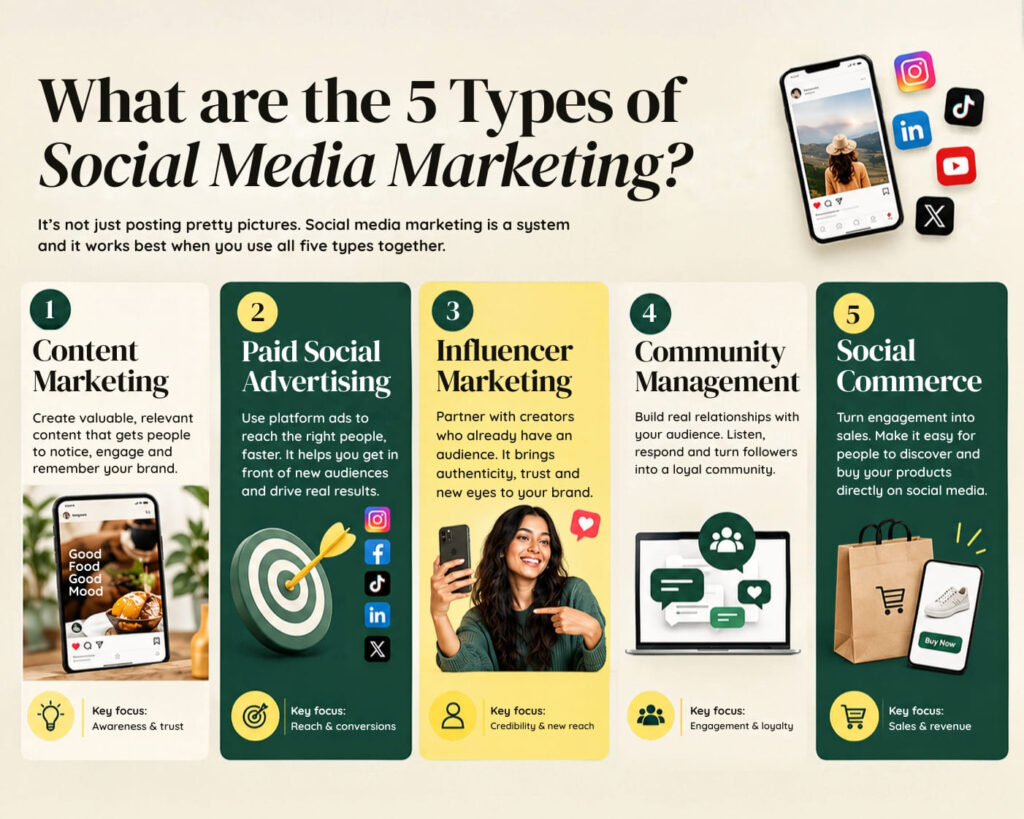
None of these five types work in isolation for very long and more important each of them support one another.
Content marketing brings people in but community management keeps them engaged. Paid ads speed up growth once you know what content works but influencer marketing borrows trust from someone your audience already follows. And social commerce turns all that attention into actual sales.
For example, a small business might post organic content for a few months and notice which posts get the most saves and shares then they put paid budget behind the best performing one. At the same time, they reply to every comment and DM which builds trust.
Once they have consistent content and a decent following, they add a shop feature to sell directly through their best performing posts.
Common mistakes that brands make
- Doing paid ads with no organic presence first. Ads work better when people can click on your profile and see real content already there.
- Picking influencers based on follower count alone. Engagement and audience fit matter more.
- Ignoring comments and DMs. This quietly kills trust over time.
- Treating every platform the same way. What works on LinkedIn rarely works the same way on TikTok.
- Giving up too early. Most accounts need consistent posting for months before results become visible.
Tools that help with each type
You don’t need a huge budget to manage all five types well. A few tools cover most of what you need.
- Content marketing: Canva for graphics, CapCut for short form video editing, a simple content calendar in Notion or Google Sheets to plan posts ahead of time
- Paid advertising: Meta Ads Manager and TikTok Ads Manager (both have built in analytics so you don’t need a separate tool when starting out)
- Influencer marketing: platforms like Upfluence or simply searching hashtags and checking engagement manually for smaller budgets
- Community management: most platforms have a native inbox but tools like Sprout Social or Buffer help when you’re managing comments across multiple accounts
- Social commerce: Instagram Shop and TikTok Shop settings inside the app (no extra software needed to get started)
Starting simple beats starting with ten different tools you never fully learn how to use.
FAQs
What is the most important type of social media marketing?
There isn’t one type that works for everyone. Content marketing and community management are usually the best starting point since they cost the least and build the foundation for the other three.
Do small businesses need all 5 types?
No. Most small businesses start with content marketing and community management before they move into paid ads or influencer marketing once they understand their audience better.
Which type of social media marketing gets the fastest results?
Paid social advertising usually shows results the fastest since you’re paying for visibility directly. Content marketing and community management take longer but tend to build more long-term trust.